The Honest Answer Depends on Four Things
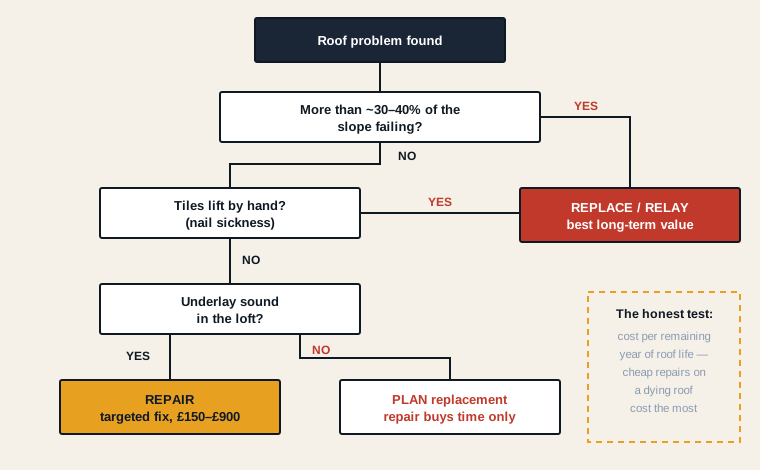
"Should I repair or replace my roof?" is the question we are asked most in Northampton, and the honest answer is: it depends on age, the extent of the failure, the cost-per-remaining-year, and whether the covering can even be reused. Here is the framework we use — and we will tell you when replacement is oversell just as readily as when patching is money wasted.
1. How Old Is the Covering?
Roof coverings have finite lives. Concrete interlocking tiles — the norm on Northampton's post-war estates like Blackthorn, Thorplands and Duston — last around 40–60 years, and many of those estate roofs are now at the top of that range. Clay plain tiles and Welsh slate on the Victorian and 1930s stock in Kingsthorpe, Abington and the terraces can last 80–100+ years, but their fixings do not — which is where nail sickness comes in. If the covering itself is sound but slipping, that is a re-fix, not a replacement.
2. How Much Has Actually Failed? The 30% Rule
Our rule of thumb: if less than about 30% of the roof has failed and the rest is sound, repair is almost always the sensible choice. Once you are past roughly a third — widespread nail sickness dropping tiles across the whole slope, failed underlay throughout, multiple valleys and the ridge all gone — you are spending good money tile-by-tile on a roof that will keep failing elsewhere, and replacement becomes the better value.
3. Cost-Per-Remaining-Year
This is the calculation that cuts through it. A £600 repair that buys five more years costs £120 a year. A £9,000 re-roof that lasts 50 years costs £180 a year — but resets the clock entirely and comes with a guarantee. If repairs are coming every couple of years on an ageing estate roof, the repair cost-per-year climbs above replacement, and that is your signal.
4. Can the Covering Be Reused?
On a nail-sick Welsh slate roof in a Northampton conservation area, the slate itself is often 70–85% reusable — a strip-and-relay refixes your original slate with new copper or stainless nails to BS 5534 for far less than new slate. That is neither a simple repair nor a full replacement; it is the middle path, and it is frequently the right one on period stock.
When Patching Is Money Wasted
If a roofer keeps patching a roof that is dropping tiles across every slope, you are paying repeatedly to delay the inevitable. Widespread nail sickness, underlay that tears when touched, and a ridge that has gone along its length are all signs the roof has reached the end — patching just moves the next leak along.
When Replacement Is Oversell
Equally: a single failed valley, a slipped ridge, or a localised area of storm damage on an otherwise sound roof does not justify a full re-roof, whatever a doorstep caller claims. If someone quotes you for a complete replacement when the roof is 25 years into a 55-year life with one failed detail, get a second opinion. We have talked plenty of Northampton homeowners out of re-roofs they did not need.
Our Steer by Northampton Stock
On the post-war estates, an estate roof past 50 with nail sickness across multiple slopes is usually a replacement; one slipped section is a repair. On 1930s semis, first-signs nail sickness on original clay is often a strip-and-relay; failed flashings alone are a repair. On Victorian terraces, reusable slate points to strip-and-relay, and shared valley or chimney lead failures are targeted repairs. On flat roofs over extensions and garages, a failed felt roof past 20 years is a replacement in EPDM or GRP; a localised split on a younger roof is a repair.
Not sure which camp your roof is in? A roof inspection gives you a definitive answer with photos, and the fee is credited against any work. Or read how we run every job on our how we work page. For the fixes themselves, see roof repairs and roof replacement.
The Signs Your Northampton Roof Is Failing
Certain signs point to genuine end-of-life rather than a one-off repair. Watch for: tiles slipping in more than one place across different slopes (widespread nail sickness); daylight visible through the roof from inside the loft; underlay (felt) that is torn, sagging between rafters, or crumbles when touched; damp staining across several areas of the loft rather than one spot; a ridge line that dips or has lost its bedding along its length; and repeated leaks that move to a new place each time it rains. One of these on its own is usually a repair. Several together, on a roof already past 45–50 years, point to replacement.
What a Re-Roof Actually Involves
A full re-roof strips the old covering, replaces the underlay (felt) and battens, renews or reuses the tiles or slate, and re-forms the ridge, valleys and flashings to current standards including mechanical fixing to BS 5534. On a typical Northampton three-bed semi it takes five to eight days with scaffold, and comes with a written ten-year workmanship guarantee. Because it resets the whole roof, the cost-per-remaining-year is low even though the upfront figure — typically £6,500–£12,500 depending on size, pitch and material — is significant. Crucially, a re-roof is the moment to add roof insulation and sort ventilation while the roof is open, which a repair cannot do.
Flat Roofs: Repair or Replace?
Flat roofs over Northampton extensions, garages and dormers follow the same logic on a shorter clock. A traditional felt flat roof past 20 years, blistering and splitting across its area, is a replacement — and the sensible replacement is EPDM rubber or GRP fibreglass, which last far longer than the old pour-and-roll felt. A single split or a lifted edge on a flat roof under ten years old is a repair. If a flat roof has ponded (held standing water) for years, replacement with corrected falls is usually money better spent than repeated patching.
Always Worth a Second Opinion
If any roofer — particularly one who knocked on your door — tells you that you need a full replacement, get an independent second opinion before agreeing. We provide honest second opinions across Northampton, and we have talked many homeowners out of unnecessary re-roofs just as often as we have confirmed that replacement was the right call. A documented roof inspection settles it with photographs, and the fee is credited against any work you go on to book. For guidance on choosing a trustworthy roofer in the first place, read our how to choose a roofer guide.
Two Worked Examples From Northampton Roofs
Example one — repair wins. A 1930s semi in Abington, roof around 55 years into a 90-year clay-tile life, developed a leak from a single failed lead valley. The covering was sound, one detail had failed, and less than 5% of the roof was involved. A valley rebuild at roughly £550 bought many more years of service — a re-roof here would have been pure oversell, discarding decades of remaining life in sound clay. Cost-per-remaining-year on the repair: negligible.
Example two — replacement wins. A concrete-tiled roof on a Blackthorn estate semi, around 55 years old, was dropping tiles across three different slopes — classic widespread nail sickness — with the underlay tearing at the eaves and the ridge bedding gone along its length. Well over a third had failed, and repairs had already come twice in three years. A full re-roof at roughly £8,500, with new underlay, battens, mechanical fixing to BS 5534 and a ten-year guarantee, reset the roof entirely. Continuing to patch would have cost more per year and never stopped the leaks migrating.
Roof Age Quick Reference for Northampton Stock
As a rough guide: concrete interlocking tiles (post-war estates) — 40–60 years, so estate roofs built in the 1960s–70s are now in the replacement window. Clay plain tiles (Victorian, 1930s) — 80–100+ years for the tile, but fixings fail sooner, so expect nail-sickness re-fixes long before replacement. Welsh slate (Victorian terraces, conservation stock) — 80–100+ years and often reusable via strip-and-relay. Felt flat roofs — 15–25 years, then replace in EPDM or GRP. EPDM/GRP flat roofs — 25–40 years. Where your roof sits against these ranges, combined with how much has actually failed, gives you the answer — and we will confirm it honestly, for free.
Get an Honest Answer — Free
Last updated: August 2026
Roof Repairs Across Northamptonshire
Select your area for local pricing and a free no-obligation quote.