If you live on one of Northampton's post-war estates — Blackthorn, Rectory Farm, Lumbertubs, Thorplands, Danes Camp — and you've noticed tiles coming loose or missing after winter storms, nail sickness is likely the cause. It's one of the most common roofing problems we deal with across the NN postcodes, and it's worth understanding properly before you spend money on repairs that won't last.
Nail sickness is the corrosion of the steel nails fixing roof tiles to battens, common on Northampton's 1960s-80s estates like Blackthorn and Rectory Farm. Once nails corrode through, tiles slip and fall. The fix is stripping the affected section, replacing felt and battens, and re-tiling with stainless steel nails.
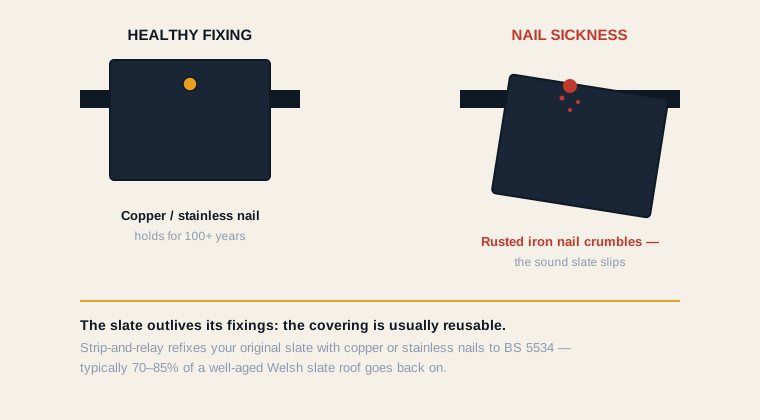
What Is Nail Sickness?
Nail sickness is the gradual corrosion of the steel nails used to fix concrete interlocking tiles to roof battens. When these estates were built in the 1960s, 70s and 80s, plain steel nails were the standard fixing. They have a finite lifespan — typically 40 to 60 years in a UK roofing environment — and most are now at or past that point.
Once the nail corrodes through, the tile is no longer mechanically fixed to the batten. It sits in position held only by gravity and the friction of surrounding tiles. In calm conditions this is fine. In a storm, or even a strong gust, tiles begin to move, lift and in some cases slide off entirely.
The problem is progressive. One corroded nail causes localised movement. Adjacent tiles that were borderline then lose their support reference and begin moving in turn. A roof that loses six tiles in January can lose twenty by the following winter.
How to Spot It on Your Northampton Property
The most obvious sign is missing or displaced tiles — particularly after wind events. But there are earlier indicators worth looking for:
British Standard BS 5534, the code of practice for slating and tiling, requires corrosion-resistant mechanical fixings - modern re-roofs use austenitic stainless steel nails to prevent the nail sickness now seen across older estates.
Source: BS 5534:2014+A2:2018
Tiles that have shifted slightly but haven't yet fallen will show gaps at the overlap with the tile below. On a concrete interlocking tile roof you should see a clean, tight overlap at every course. If you can see daylight through the overlap from ground level, tiles have moved.
Ridge tiles are often the first to show movement because they sit at the highest point and are most exposed to wind loading. If you notice ridge tiles that have rotated or shifted, the rest of the fixing system is almost certainly in the same condition.
Internally, early nail sickness often shows as light ingress in the loft during rain — not through holes in the tile itself, but through the gaps created by tile movement against the felt underlay beneath.
Which Northampton Estates Are Most Affected?
The estates built earliest are furthest through the corrosion cycle. In broad terms:
Blackthorn, Far Cotton and Rectory Farm — built through the late 1960s and 1970s — are the most advanced. We see the highest proportion of complete nail failure on these streets. Lumbertubs and Thorplands, built slightly later, are in the middle of the problem period. Danes Camp in Duston and the St Crispin development are slightly later again but are now firmly in the risk window.
The direction the roof faces makes a difference too. North-facing slopes retain moisture longer, accelerating corrosion. Properties with significant tree cover — where the roof stays damp — show faster nail deterioration than those in full sun.
What a Proper Repair Involves
The wrong repair is to simply replace the fallen tiles and leave the underlying fixing system in place. If the nails on the fallen tiles have corroded, the nails on every tile in the same course have corroded too. Replacing isolated tiles on a nail-sick roof is the roofing equivalent of patching one piece of rusty bodywork — the problem continues to develop everywhere else.
A proper nail sickness repair involves identifying the affected section (a survey will determine how far it extends), stripping that section back to the rafters, replacing the breathable felt underlay, fitting new treated timber battens, and re-tiling using the correct tile profile with stainless steel ring-shank nails — which will outlast the roof itself.
The cost varies by extent. A rear slope section on a standard semi in Blackthorn or Rectory Farm typically runs £600 to £1,400 depending on size. A full re-roof — which is sometimes the right answer when nail sickness extends across the whole roof — costs £5,500 to £9,000 for a 3-bed semi. We'll always survey first and give you an honest assessment of which approach makes better economic sense.
When to Act
The practical answer is: before the first storm of the season. Nail sickness that is borderline in September becomes a tile-loss event in November. A survey in late summer gives you time to plan and book a repair before the weather turns.
If you've already lost tiles, the priority is to get the openings temporarily weatherproofed the same day — exposed felt underlay deteriorates rapidly once tiles are gone. Call us and we'll attend the same day to make the roof safe, then assess the full extent properly.
If you're not sure whether your Northampton property has nail sickness, we offer free surveys across all NN postcodes. We'll give you a clear condition report and a repair recommendation with no obligation.
Free surveys across all NN postcodes. Call 0160 428 1189 or request a quote online.
Last reviewed: July 2026
Why Nail Sickness Hits Northampton's Estates Together
Nail sickness — sound tiles slipping because their steel fixing nails have rusted through — tends to arrive across a whole estate at once, because the houses were built in the same few years with the same fixings. Northampton's post-war estates like Blackthorn, Rectory Farm and Thorplands are now at exactly the age where the original nails, with a 40–60 year corrosion life, are failing en masse. That is why a street can go from the odd slipped tile to widespread slippage within a few seasons. The tile itself is usually fine; it is the fixing that has gone, which is what makes re-fixing (rather than replacing the tiles) the right answer in many cases.
Repair, Re-Fix or Re-Roof?
The decision hinges on how far the nail sickness has spread. A handful of slipped tiles on an otherwise sound roof is a re-fix job — we replace the failed fixings with new stainless or copper nails, or clips, to hold the sound tiles. Once slippage is widespread across multiple slopes and the underlay beneath is also failing, tile-by-tile re-fixing becomes false economy, and a re-roof — new underlay, battens and mechanical fixing to BS 5534 — is the better value because it resets the whole roof for decades. We will always tell you honestly which stage your roof has reached.
What Re-Fixing Actually Involves
When nail sickness is localised enough to re-fix rather than re-roof, the work is more skilled than it sounds. We lift the slipped tiles or slates, remove the corroded fixings, and re-secure the sound coverings with new stainless steel or copper nails, or with clips where the batten allows — fixings chosen precisely because they won't corrode the way the originals did. On a slate roof this is a strip-and-relay in miniature; on a concrete-tile estate roof it's targeted re-fixing of the affected courses. The result restores the roof without the cost and disruption of a full replacement, and because the new fixings outlast the old, it doesn't simply recur in a few years. The judgement call — and the honest one — is knowing when re-fixing is genuinely worthwhile and when the slippage is so widespread that you'd be re-fixing your way to the cost of a re-roof anyway.
Frequently Asked Questions
What exactly is nail sickness? It's the corrosion of the steel nails fixing your tiles or slates. The fixings fail while the tiles themselves stay sound, so tiles slip and fall despite looking fine.
Can nail sickness be repaired without a full re-roof? If it's localised, yes — we re-fix the sound tiles with new stainless or copper fixings. Once it's widespread across slopes, a re-roof is usually better value.
Why is my whole street getting it at once? Because the houses were built together with the same fixings, which reach the end of their corrosion life at roughly the same time.
Are my tiles ruined? Usually not — the tiles are typically fine and reusable. It's the nails that have failed, which is why re-fixing works.