Modern flat roof systems — GRP fibreglass and EPDM rubber — are capable of 35 to 50 years of service life when correctly installed and maintained. The previous generation of three-layer felt gave flat roofing a poor reputation by failing in 10 to 15 years. The newer systems are a fundamentally different product, but they still benefit from periodic attention. This guide is written for Northampton homeowners with GRP or EPDM flat roofs on extensions, garages and outbuildings.
Flat roof maintenance in Northampton means keeping outlets clear, checking upstand junctions where most leaks start, and inspecting the membrane for blisters or cracks. Standing water indicates inadequate falls. GRP and EPDM roofs need minimal maintenance; ageing felt roofs should be inspected annually before winter arrives.
The Annual Check
A flat roof should be checked visually once a year — autumn is the best time, clearing any debris before winter rain. The check can be done from ground level for most flat roofs, supplemented by a close look from a ladder at the upstand junctions if safe access allows.
What you are looking for: debris accumulation on the deck (leaves, twigs, moss growth) that could block outlets and cause standing water; the condition of the upstand where the flat roof meets the wall — this junction is the most thermally active point on a flat roof and the most common source of failure; the condition of any penetrations through the membrane (pipe outlets, drainage outlets); and any visible surface damage — cracks, blisters, or areas where the membrane looks different from the surrounding surface.
On a well-installed GRP flat roof in good condition, the surface should be hard, consistent in colour (some weathering and chalking is normal), and completely intact at all edges and upstands. Soft or spongy areas, visible cracks, or upstands that have pulled away from the wall all warrant professional attention.
Keeping Outlets Clear
Blocked outlets are the single most common cause of flat roof deterioration in Northampton. When an outlet blocks and water ponds on the deck, it accelerates biological growth (algae, moss), adds weight that the deck structure carries continuously, and saturates the membrane edge at the upstand.
Northampton's mature residential areas — Kingsthorpe, Abington, Spinney Hill, Billing — produce significant autumn leaf fall that ends up on flat roofs as well as in gutters. An annual clear of all flat roof outlets in November, before the worst of the leaf fall is over, is the most cost-effective flat roof maintenance you can carry out.
Moss growth on the flat roof deck surface is a sign that the deck is retaining moisture. Soft washing with a biodegradable biocide — the same treatment used on pitched tiles — can be applied to a GRP or EPDM deck safely. Pressure washing should not be used on flat roof membranes.
The Upstand: Where Most Failures Start
The upstand is the section of membrane that runs vertically up the wall at the edge of the flat roof. It is the most thermally active point on the roof — the junction between the roof membrane, the wall surface and the wall capping experiences expansion and contraction with every temperature change.
On a well-installed flat roof, the upstand terminates behind a cover flashing fixed to the wall, and the bottom edge of the cover flashing is sealed with a compatible sealant. This detail allows the membrane to move with thermal cycling without creating a gap that lets water in.
Failed upstands — where the membrane has pulled away from the wall, the sealant has cracked, or the cover flashing has lifted — are responsible for the majority of flat roof leaks we repair on Northampton extensions. The failure is usually visible on close inspection of the upstand junction. A repair to a failed upstand costs £200 to £450 and, done correctly, will last the remaining life of the membrane.
When to Call a Professional
The key situations that warrant professional attention rather than continued monitoring are: any visible crack or split in the membrane surface; any upstand junction that has visibly pulled away or shows daylight; standing water that remains on the deck 48 hours after rainfall (indicating a drainage problem); any soft or spongy area when walked on (indicating deck deterioration below the membrane); and any internal staining on the ceiling below the flat roof.
For Northampton's 1980s and early 1990s housing stock — where GRP flat roofs on rear extensions and garages are now 30 to 40 years old — the condition of the upstand termination is the primary thing to check. Many installations from this period used now-outdated termination methods that are beginning to fail as the sealant ages. A professional inspection can identify whether a full membrane replacement is needed or whether targeted upstand repair will extend the life for another decade.
Call us on 0160 428 1189 for a free flat roof condition survey. We assess deck condition, membrane integrity, upstand detail and drainage, and provide a written recommendation on whether the roof needs maintenance work, targeted repair, or full replacement.
Free surveys across all NN postcodes. Call 0160 428 1189 or request a quote online.
Extending the Life of Your Flat Roof
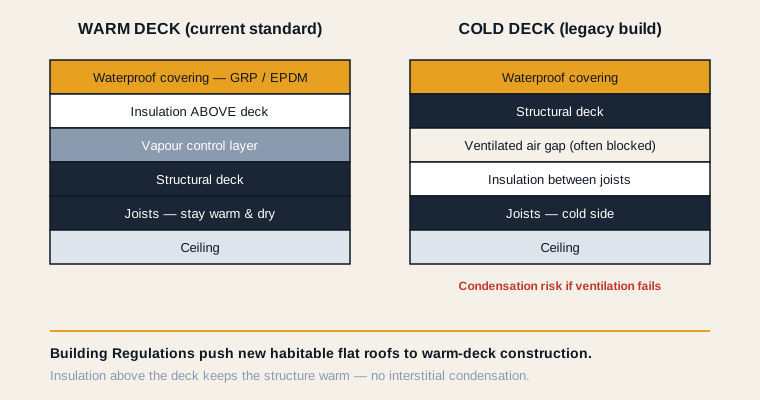
A modern flat roof can reach the top of its 25–40 year range with basic care, or fail early through neglect. The biggest enemy is standing water: keep outlets and surrounding gutters clear so the roof drains as designed, because ponding accelerates every kind of failure. Clear leaves and debris that trap moisture, particularly under any overhanging trees. Check the perimeter details — the trims and the upstands where the roof turns up against a wall — since these junctions fail before the field of the roof does. Avoid walking on the roof unnecessarily, and never drag anything sharp across it. On a warm-deck roof, keep ventilation paths clear. And after any significant storm, take a look for lifted edges or impact damage. None of this is difficult or costly, and it's the difference between a flat roof that quietly does its job for decades and one that surprises you with a leak.
A modern flat roof asks very little of you — keep the outlets clear, glance over the edges and upstands a couple of times a year, and check it after storms — and in return it quietly does its job for decades. Most early failures we're called to on Northampton extensions trace back to ponding from blocked outlets or lost falls, both avoidable. If your flat roof is showing any signs of trouble, or you'd simply like it checked before a small issue becomes a leaking ceiling, we're happy to take a look and tell you honestly whether it needs anything at all.
We cover flat roof work right across Northampton and the surrounding Northamptonshire towns — from the terraces of Semilong, St James and Far Cotton to the estates of Blackthorn, Duston and Kingsthorpe, and out to Wellingborough, Kettering, Daventry and the villages. Wherever you are, the approach is the same: an honest assessment first, a written itemised quote with no call-out fee, tidy work by a local team, and a 10-year workmanship guarantee. If anything in this guide matches what you’re seeing on your own roof, a quick free survey will give you a clear, no-pressure answer on what — if anything — needs doing.
Frequently Asked Questions
Last reviewed: July 2026